Weights that progress themselves
Hit the top of your rep range on every working set and the load goes up next time. Miss it and the weight holds. No spreadsheet, no arguing with yourself at the rack.
One tap to your next workout.
You never pick a muscle group, never build a routine, never wonder if you've skipped legs again. Tap once and the session is there — chosen, ordered and loaded.

Free on the App Store · iPhone · iOS 17
How it decides
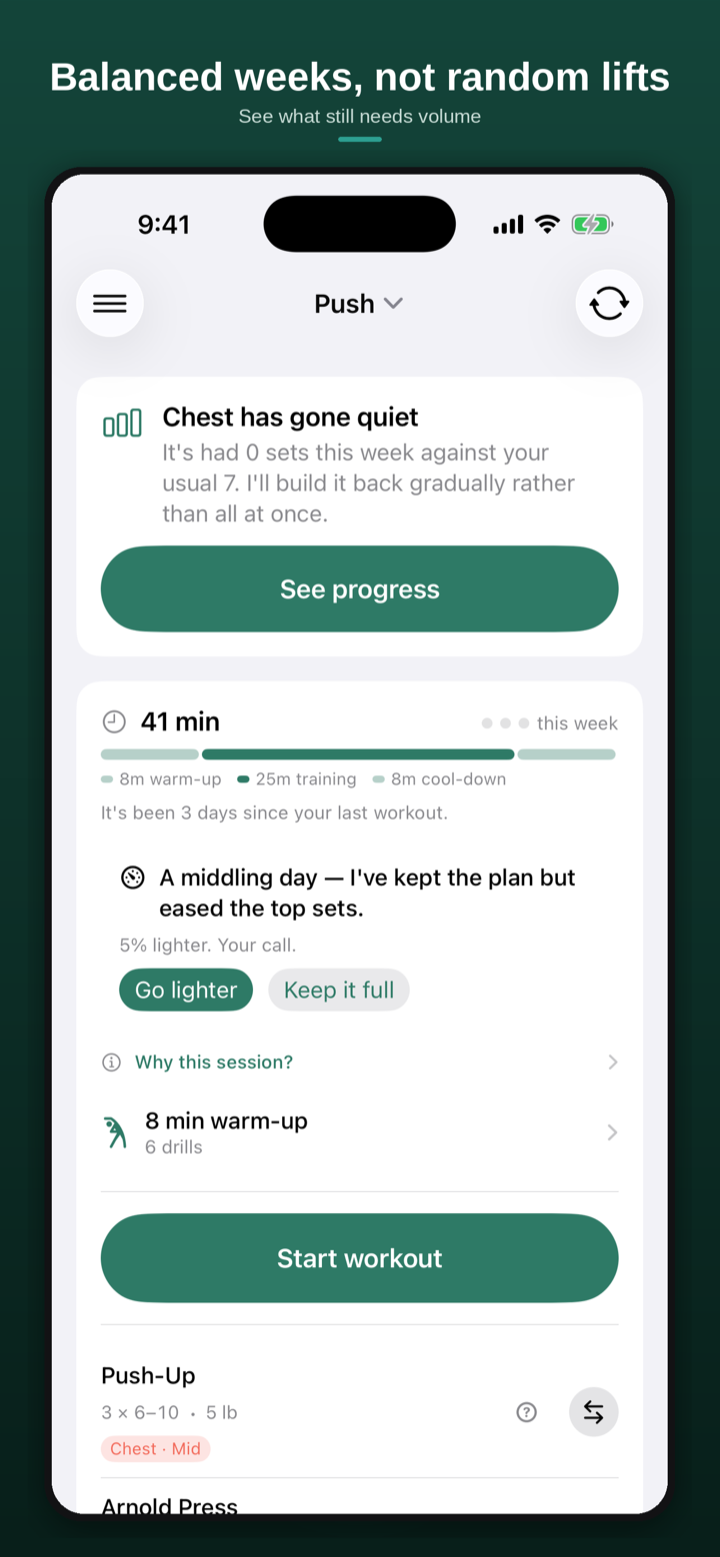
Most apps hand you a template and hope you stick to it. True Balance keeps a rolling seven-day picture of your training across eleven muscle groups, each with its own weekly set target. Every set you log credits the muscles it actually worked — then the next session is built from whatever is furthest behind.
The guarantee is weekly, not daily. One workout may lean push or legs, but nothing is allowed to quietly fall behind.
What it does
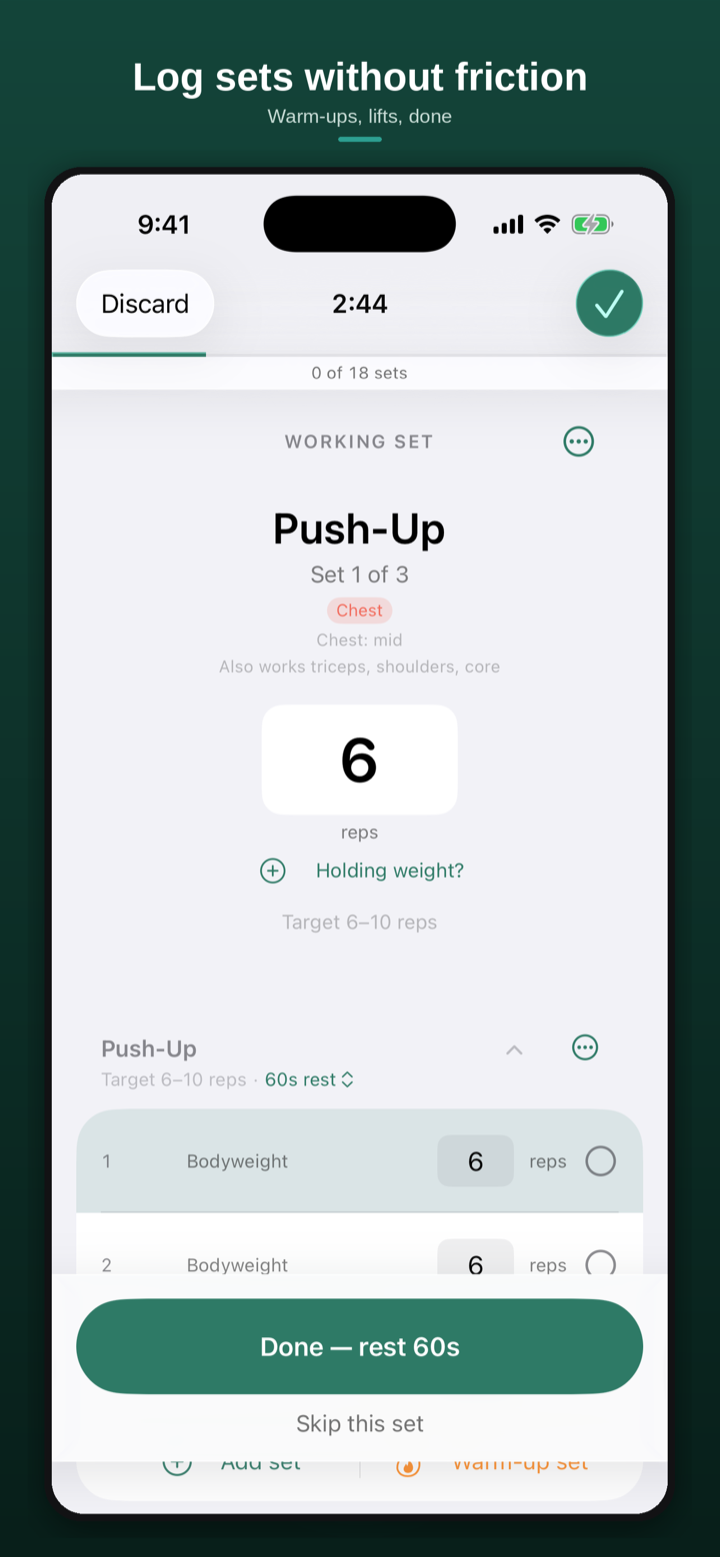
Hit the top of your rep range on every working set and the load goes up next time. Miss it and the weight holds. No spreadsheet, no arguing with yourself at the rack.
Tell it what equipment you have and 153 exercises are filtered to the ones you can genuinely perform — barbell, dumbbells, bands, or nothing at all.
Save your gym, your home setup, and somewhere for a week away. Switch place and the equipment switches with it, so a hotel week never produces a barbell session.
Set your session length and it budgets against the clock — warm-up, training and cool-down — and tells you plainly when it had to trim something to fit.
A rest timer, and a Lock Screen and Dynamic Island card showing your current set and time remaining — so your phone stays in your pocket between sets.
Full body, upper/lower, or push/pull/legs. Choose one and everything else still runs inside the day — deficits pick the movements, recovery orders them.
Packs
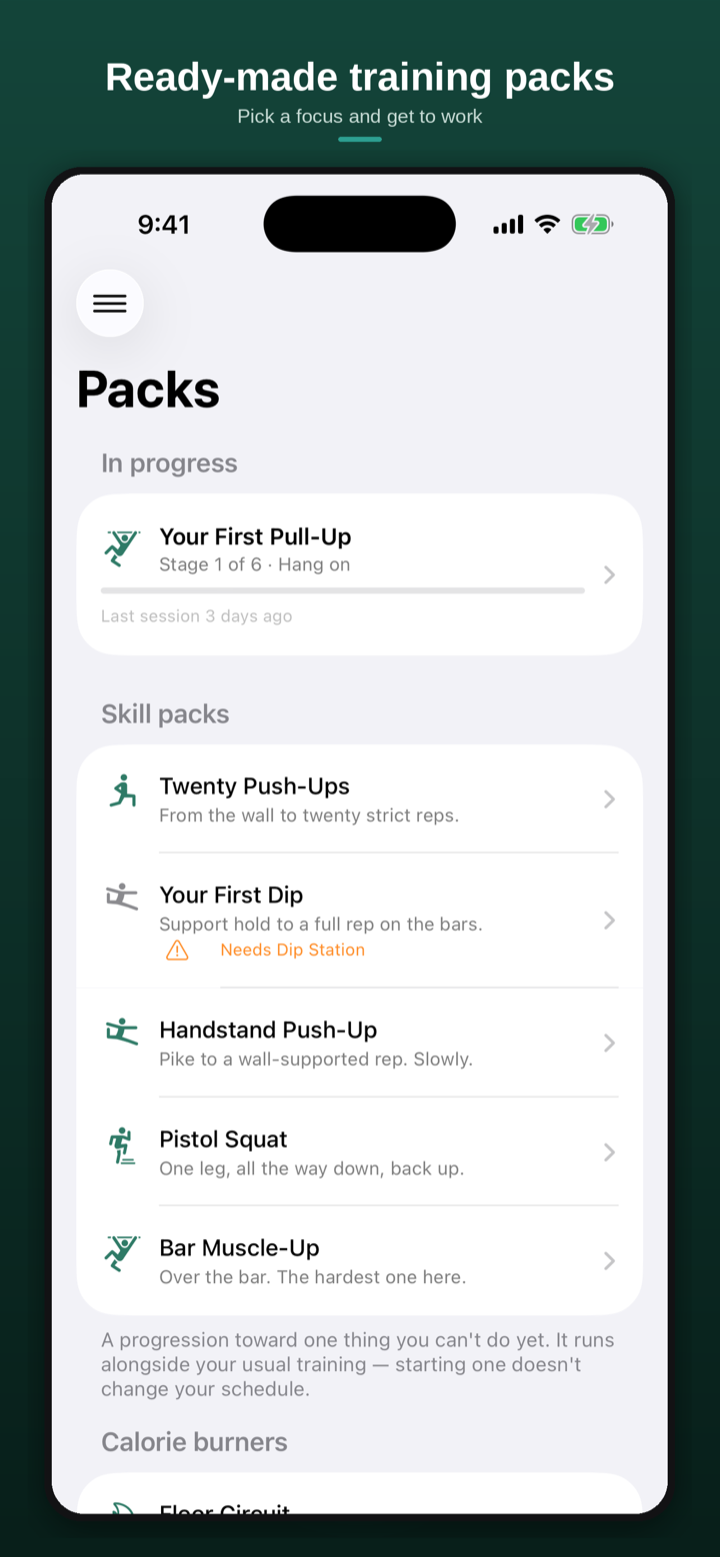
A first pull-up. A first dip. Twenty push-ups, a handstand push-up, a pistol squat, a bar muscle-up. Each one is a six-stage progression that runs alongside your ordinary training, not instead of it — start one today and your Tuesday is still your Tuesday.
You move up when you earn it, never on a schedule. A stage ends when you hit its number twice, because hitting it once is a good day and hitting it twice is a capability. If life gets in the way, pause — a pack keeps your place indefinitely.
Your First Pull-Up — stage 3 of 6
Dead hangs and scapular pulls. Most people who can't do a pull-up can't hang for thirty seconds either.
A horizontal pull at a load you can actually control.
You're stronger lowering than lifting, always. Target: 20s flexed-arm hang
Full range, on the lightest assistance that gets you five.
Singles, fully rested. One good rep beats three scrappy ones.
One rep is a moment. Three is a pull-up you own.
The coach
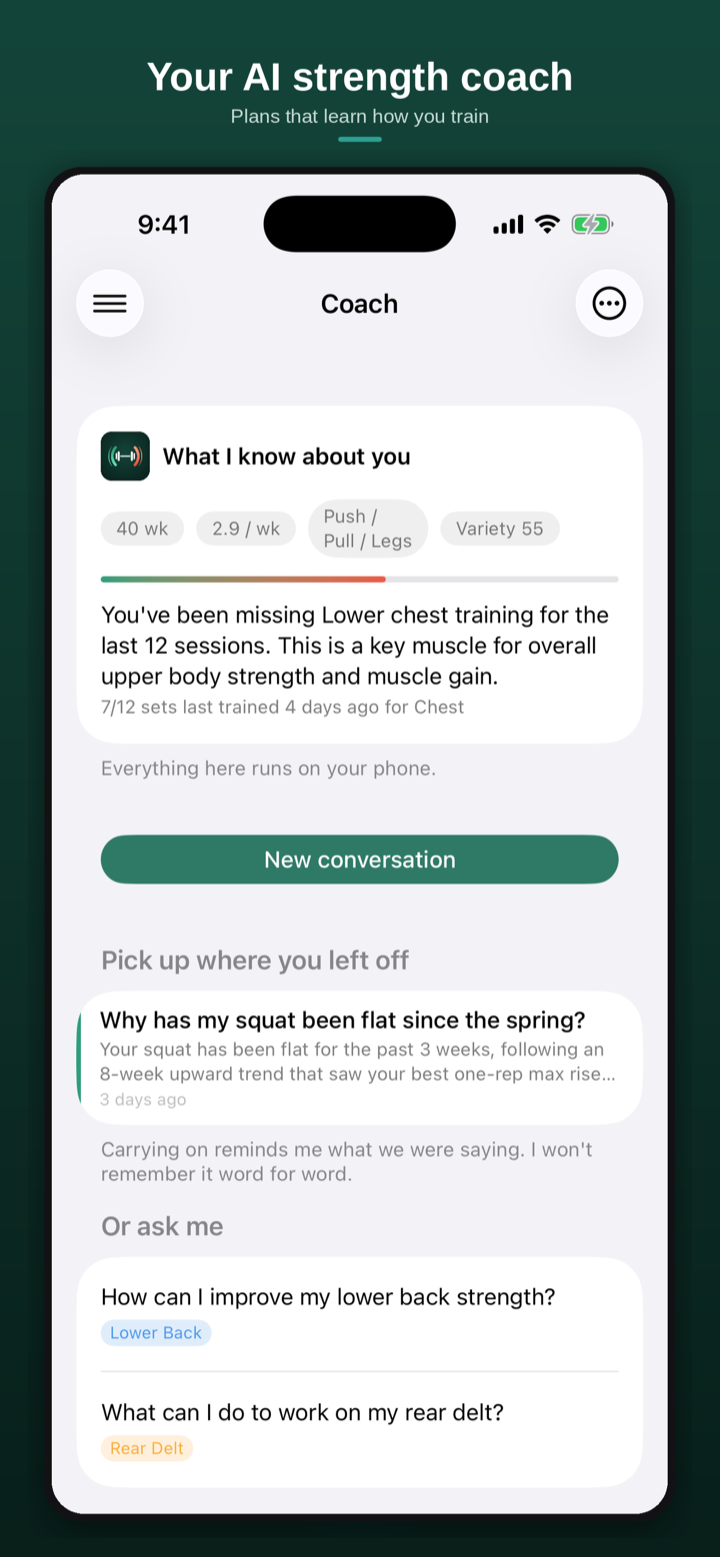
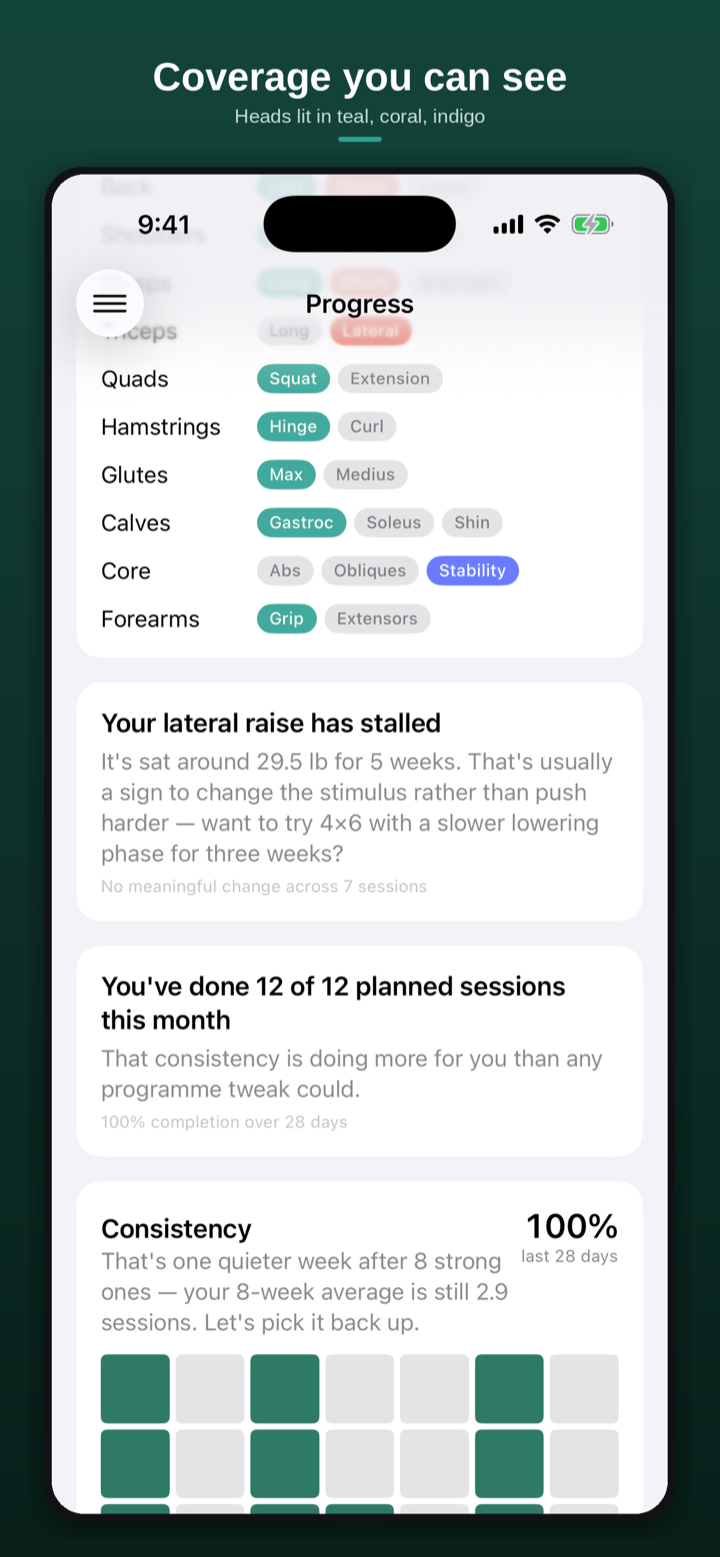
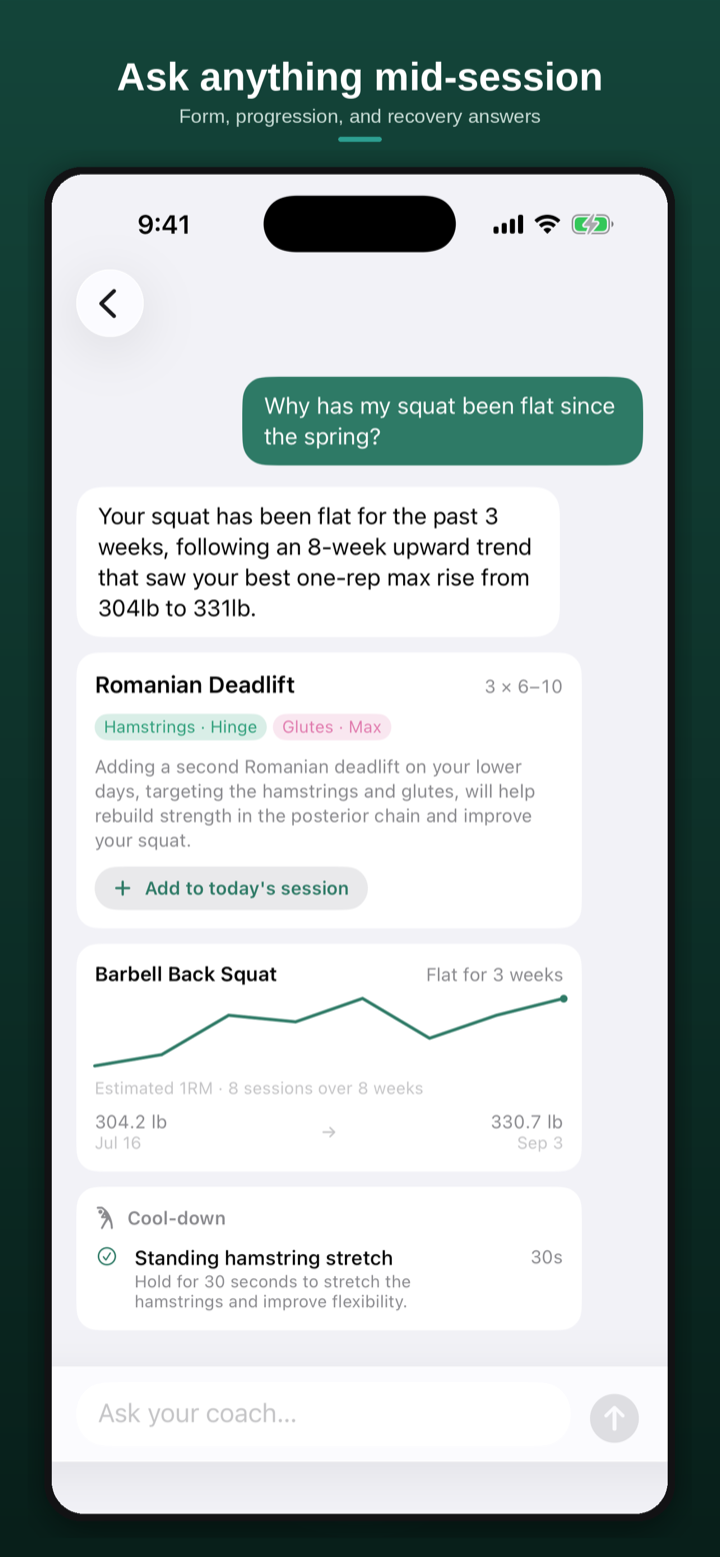
Once you've logged fifteen sessions, the app reads all of them and you can start asking questions. Not general advice — answers about your training, quoting your own numbers back at you, because a claim you can't check is just a confident opinion.
It knows what's stalled, what's under-trained and how reliably you actually show up. Suggest something and it arrives as a card you can put straight into today's session.
There is a short wait, and it is the point. A trend needs enough sessions to be a trend and a plateau needs something to compare against — a coach that answers before then is just guessing about your body. Fifteen is where the numbers start meaning something.
Runs entirely on your phoneNeeds iOS 26 and a device that supports Apple Intelligence. Everything else in True Balance works without it.
Long head of the triceps, which nothing you're currently doing trains at length.
+ Add to today's sessionA look inside
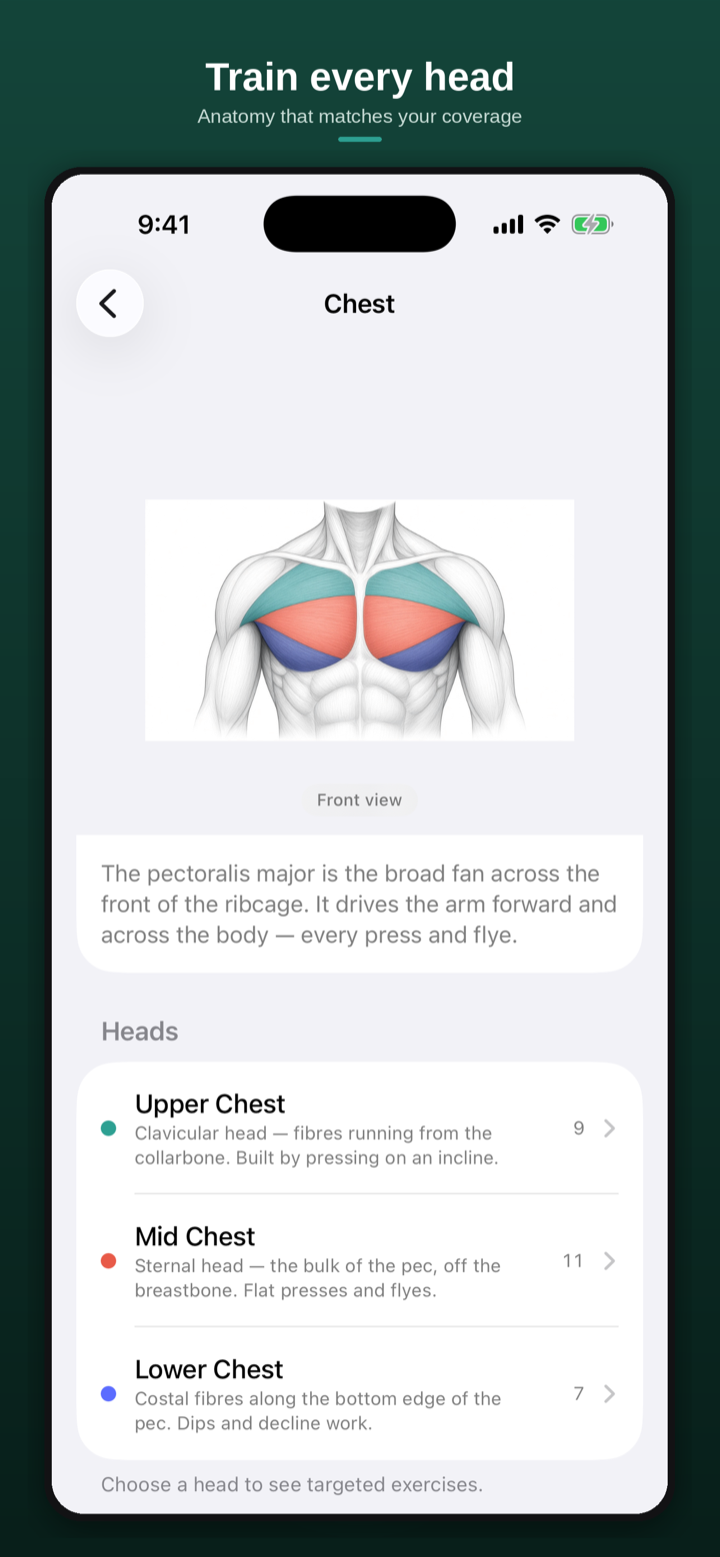
The same screens as the App Store listing — the coach, the packs, the anatomy, and the session you actually tap.
Where it draws the line
A short check-in before each session sets the day's volume and load. Flag sharp pain in a joint and every movement loading that joint disappears from the plan. Report anything cardiac-adjacent and suggestions pause until you've acknowledged it. Nothing is ever removed silently.
True Balance is a fitness app, not a clinician. It can't see you, can't watch your form, and knows only what you tell it. It does not teach technique, and its suggestions are produced by software from the answers you give it.
Every figure it shows — calories, estimated one-rep max, readiness — is an estimate from a formula, not a measurement. If anything about your health is uncertain, speak to a qualified professional before you start.
The deal
No account to create. No email address. No advertising, no subscription, and no paid tier — every feature is simply in the app. Your training data lives on your device and in your own private iCloud, and goes nowhere else. It is never sold and never shared.
Free · iPhone · iOS 17